
|
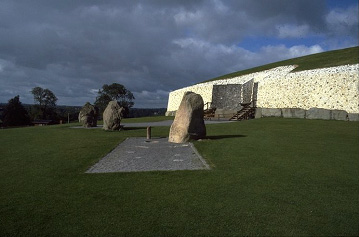
| Newgrange, "a pearly hockey puck, capped in green velvet and grown gigantic on the sloping fields." (Photograph © Clive Ruggles, University of Leicester.) |
Background:
On a beautiful grassy slope that is as green as only rural Ireland can
be, nestled in a quiet bend of the Boinne River in County Meath just 26 miles
north of the country's largest city, Dublin, are three ancient tombs:
Knowth, Dowth, and Newgrange. They are mounds of earth, nearly circular, that
are roughly 90 meters (300 feet) in diameter and arranged in a sort of narrow
triangle (see diagram below). Around the base of each mound is a series of large
stones, known as curbstones, many of which are ornamented with elaborate carved
patterns. Like the Great Pyramids of Egypt, the Boinne River monuments are "passage
tombs"—meaning that the burial site is reached by way of a passage
into the central recesses of a large structure.
 |
The mounds are ancient by any appropriate comparison. Although Knowth and Dowth may have been built somewhat later, carbon-14 data taken from Newgrange place its age at roughly 3200–3100 BC, making it one of the oldest known structures in the world with clear astronomical intent—not as old as the stone pillars at Nabta Playa in Egypt, but older than the Sarsen Circle at Stonehenge or any of the North American medicine wheels.
Astronomical Significance:
All three of the mounds have astronomical alignments. Dowth contains a tomb
passage that is aligned with sunset on the winter
solstice. Knowth contains two interior tombs reached by separate tunnels,
one from the east and the other from the west, so that they line up, respectively,
with the rising and setting of the Sun on the spring and fall equinoxes. These
two tunnels form a nearly perfect east–west line, and by their sheer length—they
are the longest of any of the tomb passages at the site—they determine
that even slight shifts in the rising point of the Sun will cause different
parts of the interior to be illuminated. (Interestingly, it is only the east
passage that ever admits sunlight directly to its inner tomb. The west passage
has a "kink," a bend to the right near the end that pinches off
any daylight from ever reaching the tomb to which it leads.)
 |
| The front entrance to Newgrange. (Photograph © Clive Ruggles, University of Leicester.) |
The most dramatic alignment of all, however, is at Newgrange. Unlike Knowth and Dowth, the earthen mound of Newgrange—or "Brugh-na-boinne," as it is known locally—is enclosed all around by a vertical wall of white quartz (reconstructed by the archaeologist Michael O’Kelly), making it a striking structure by any account. The description provided by Edwin Krupp, who refers to Newgrange as "a pearly hockey puck, capped in green velvet and grown gigantic on the sloping fields,"* is as illustrative as any photograph.
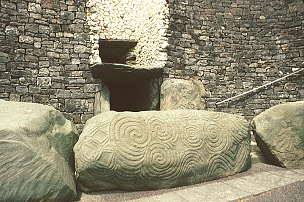 |
| The entrance to the passage at Newgrange showing both the doorway and the "roof box" directly above it. Note also the ornamented curbstone in the foreground. (Photograph © Mary Ann Sullivan.) |
The single tomb within, with its 6-meter- (20-foot-) high ceiling, is entered by way of a straight, 19-meter- (62-foot-) long passage that is aligned with the direction in which the Sun rises on the winter solstice. Because the passage slopes gently upwards, any sunlight that enters through the door itself is lost to the passage floor and never reaches the inner chambers. However, just above the door is a rectangular window, or "roof box," that had been hidden until O'Kelly discovered it in the course of his extensive renovation of the area in the 1960s. On the morning of the winter solstice, four minutes after sunrise, a beam of sunlight passing through this window reaches all the way down the long entrance passage and for 17 minutes illumines the innermost chamber. It is a breathtaking sight, and that it still has power to arrest the attention of our modern world is clear from the fact that more than 20,000 people each year submit their names in the hopes of being allowed to witness the event in person!
 |
| The three spirals carved in stone in the inner chamber of Newgrange. (Photograph © Clive Ruggles, University of Leicester.) |
As dramatic as it is today, when this megalith was first completed, the experience would have been even more profound. Careful analysis taking into account the precession of Earth's rotation axis has shown that 5000 years ago there would have been no four-minute delay after sunrise. The Sun's very first light would have shot a narrow beam down the tunnel illuminating the inner chamber. Furthermore, stones positioned to catch the beam would have reflected the light onto a distinctive carving of three spirals, a discovery that dispels any doubts about the deliberation and care that went into constructing this monument.
 |
| Photograph © Clive Ruggles, University of Leicester. |
Newgrange, Knowth and Dowth were built by people who had no written language, and so had no means of communicating to us their reasons for putting such effort into these particular tombs. By the number of bones found within each one (which is very few), it is clear that these were not simply community graveyards. The people whose earthly remains were placed within were singled out for some reason.
The astronomical alignments support this conclusion, especially those at Newgrange. The winter solstice is a special time. For many cultures it has represented the end of the old and the beginning of the new. The Sun reaches its lowest point in the sky, drawing to a close its gradual retreat as it simultaneously begins the slow process of return. This magnificent structure was carefully designed and laboriously built to allow the Sun to shine its light on one particular grave site on this one day of each year.
Citations:
* E.C. Krupp, Skywatchers, Shamans & Kings: Astronomy and the
Archaeology of Power, John Wiley & Sons, Inc., New York, 1997, p.
137.
References:
Kelley, D., and E. Milone, Exploring Ancient Skies: An Encyclopedic
Survey of Archaeoastronomy, Springer, New York, 2005.
Krupp, E.C., Echoes of the Ancient Skies: The Astronomy of Lost Civilizations, Harper & Row, New York, 1983.
Krupp, E.C., Skywatchers, Shamans & Kings: Astronomy and the Archaeology
of Power, John Wiley & Sons, Inc., New York, 1997.
Other useful links and references:
Diagram
of Newgrange
Knowth.com
Ireland: Light,
Body and Soul
Mythical Ireland