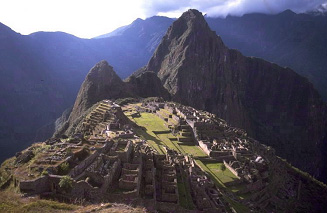
Surrounded by the Andes Mountains of modern day Peru, perched on a ridge high above the Urubamba River gorge, sits one of the most remarkable cities of the ancient world: Machu Picchu.
Background:
Surrounded by the Andes Mountains of modern day Peru, perched on a ridge high
above the Urubamba River gorge, sits one of the most remarkable cities of the
ancient world: Machu Picchu.
Machu Picchu was originally part of the vast Incan empire. Its remote location makes it unlikely that it served any military use. Built by an Incan ruler in the 15th century AD, it appears to have provided a home for some 1,200 inhabitants who, using sophisticated terracing methods, were able to provide for their own agricultural needs.
The site is of particular importance to archaeologists today since it appears
to have escaped the notice of the Spanish conquistadors, and hence contains
elements of Incan architecture and culture that were destroyed in other cities.
Astronomical significance:
Machu Picchu has at least two structures that may have had astronomical importance.
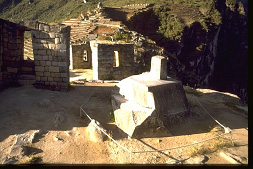
The first is a stone pillar that the Incas called "for tying the Sun,"
or "intihuatana." This pillar may have been associated with the winter
solstice.
 Why
the winter solstice? Well, to some ancient peoples who didn't understand the
inevitability of celestial events, the time leading up to the winter solstice
was a time of uncertainty. The Sun was getting lower and lower in the sky, and
showing itself for less and less time each day. Would it disappear for good?
Why
the winter solstice? Well, to some ancient peoples who didn't understand the
inevitability of celestial events, the time leading up to the winter solstice
was a time of uncertainty. The Sun was getting lower and lower in the sky, and
showing itself for less and less time each day. Would it disappear for good?
Various cultures had ceremonies they would perform during the days leading up
to the winter solstice to try to convince the Sun to return to its high place
in the sky. Some have suggested that the Incas dealt with this by performing
a ceremony to "tie" the Sun to the intihuatana so that it wouldn't
disappear forever. Other Incan cities are known to have had intihuatanas that
were destroyed by the Spanish in the 16th century. The one at Machu Picchu still
stands—a monument perhaps to humanity's early attempts to make sense
of the cosmos.
The second structure of interest astronomically is a room known as the Torreon
which may have been a primitive observatory. It includes a natural stone altar
that is enclosed by a beautifully designed spiral wall, with windows of various
shapes and sizes built into it.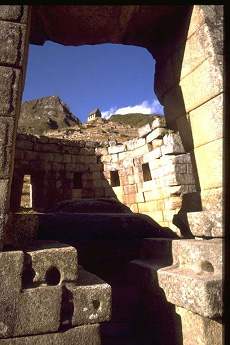
These windows appear to have been deliberately placed so as to provide views
of particular astronomical objects and events. For example, when seen from the
stone altar, one window facing southeast provides a view of the Andean constellation,
Collca, rising, while through another northeast–facing window, one can
watch the Pleiades rising.
Both the Pleiades and Collca are known to have played an important role in Incan
culture. The northeast-facing window can also be used to determine the date
of the summer solstice.
These interpretations of both the intihuatana and the Torreon remain controversial.
But whether or not the particulars are correct, it seems clear that the builders
of Machu Picchu had astronomy in mind for at least some part of its design.
References:
Krupp, E.C., Echoes of the Ancient Skies: The Astronomy of Lost Civilizations, Harper & Row, New York, 1983.
"Machu Picchu," in the Minnesota
State University emuseum
(http://www.mnsu.edu/emuseum)
Other useful links:
Images
of Machu Picchu
Satellite
Images
All photographs copyright © Clive Ruggles, University of Leicester.